Tom Washburn
The Robot Who Looked Like MeTom Washburn is a celebrated gunfighter in The Movie who has won fame, wealth, and a young wife, yet cannot simply leave the violence of his role behind. His final return to The Set makes the distance between playing a gunfighter and being one the story’s central question: when the showdown arrives, Washburn stakes his life on the answer.
Identity and the Choice to Return
By the time the prospect of a final match arises, Washburn is retired and safe at his home in Bel Air. He had spoken about wanting to end his career with a dramatic showdown, but distinguishes that talk from an actual fight: he had not been set up by his agent, Gordon Simms, yet Simms involved him in a situation Washburn believes he should have been allowed to decide about for himself. He accepts that the arrangement makes both men look foolish—Washburn for speaking carelessly about a final match, and Simms for taking him at his word.
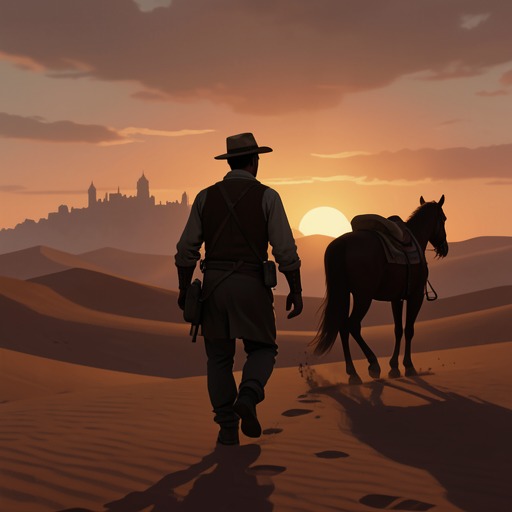
A friend urges him to leave The Movie while he is ahead. Washburn has already gained everything the Western world can offer him: he is a hero, rich, and married to a pretty young wife. The warning is not that he lacks anything, but that staying risks losing what he has won. Washburn says he is not planning to return, even as his hand settles on his gun butt. Alone in the saloon, with whiskey and a thin black Mexican cigar, he weighs the safer route back to the Wells Fargo Station and out into the wider world. Instead, he resolves to leave The Set by way of Brimstone, at its extreme northeastern corner, and ride the full length of The Territory. The detour is deliberate: he will not let Little Joe Potter find him waiting in Comanche Town, but neither will he simply disappear.
Parker’s Challenge and the Final Showdown
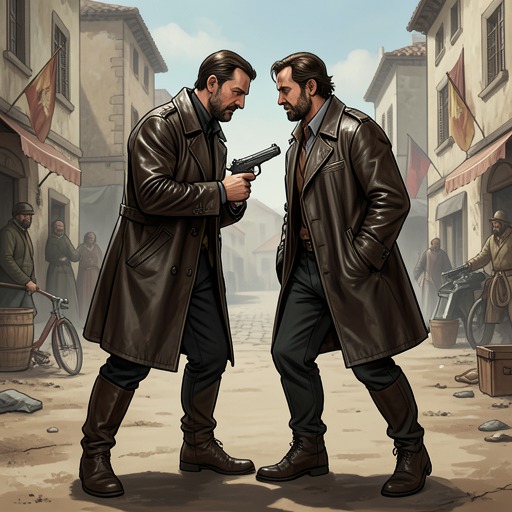
Natchez Parker tries to stop Washburn from leaving by turning the argument away from the mechanics of the scene and toward the life the two men have made inside it. He insists that their work as gunfighters carries a price: they cannot perform courage only while it is easy, then abandon it when the ending becomes dangerous. In his account, they have been more than actors in cowboy clothes. They have lived their parts and staked their lives on them. Parker grounds the appeal in their shared history, recalling Washburn’s arrival in The Territory as a frightened, inexperienced young man who made a place for himself through sheer guts. He says they have been closer than kin ever since, and refuses to let Washburn run away.
Washburn resists Parker’s appeal by treating it as bad acting: he praises the speech, says Parker has blown the scene, and tells him to get back in character. Parker rejects that evasion. He says he is speaking plainly to Washburn, not performing for The Movie or its scene. The exchange exposes the strain in Washburn’s attempt to distinguish the role from the man: Parker’s point is that, in this world, the distinction cannot protect either of them from what their roles demand.
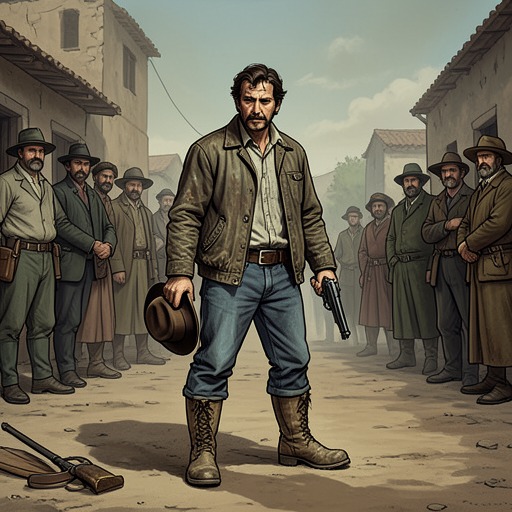
Washburn does return to face Little Joe Potter. As he dismounts, he sends his horse out of the line of fire and walks slowly toward his opponent. Little Joe asks whether he has come back for his hat; Washburn answers that he has come back because it is their dance. The two men laugh at the absurdity of the moment, then draw. Their .44s crack through the town, and smoke and dust briefly hide them. When the air clears, both are still standing, but Little Joe’s gun points down. He twirls it, watches it fall from his hand, and collapses.
The apparent victory does not give Washburn a way out. A wavering voice calls for him to draw, and he whirls toward the sound, trying to free his gun hand and move out of the line of fire. Despite his cramped posture, he draws and turns toward a freckle-faced kid ten yards away, already aiming and firing. The bullets strike Washburn; the narrative renders his death as the destruction of the world and of the image-making apparatus through which it has been seen. Sunlight bursts in his head, his horse screams, and the world goes black.
After Washburn’s death, the perspective pulls back to a viewer who has been watching the darkened screen. The viewer stirs in an easy chair, rubs his chin, belches, and switches the screen off. Washburn’s final defeat thus closes both the gunfighter’s life and the spectacle that contained it: the role has not merely been played to its ending, but has ended with the man inside it.
Performance, Identity, and the Cost of an Ending
Washburn’s final sequence turns Parker’s argument about living a part into the structure of the scene itself. The duel with Little Joe ends with one gunfighter standing and the other collapsing, but the victory immediately gives way to a second, unannounced draw: the freckle-faced kid calls for Washburn to draw and shoots him. The reversal makes survival within the Western’s familiar showdown logic temporary, not secure. At the moment of death, Washburn’s perception breaks into images of a shattered picture-making machine, a broken lens, and a world going black; then the narrative cuts outward to a spectator in an easy chair, who switches off the screen. The shift from embodied danger to a viewer’s casual gesture leaves the performance both complete and disposable: Washburn has lived the role to its lethal end, while the audience can simply turn away.
Agency Within the Western
Washburn’s last choices are neither wholly free nor wholly imposed. He objects that Gordon Simms has drawn him into a danger he should have been able to judge for himself, yet when he considers escape, he rejects the safest route and chooses a circuit through The Territory. That decision gives him a measure of control over how he returns, not over what return will cost. Parker’s appeal makes the contradiction explicit: in The Movie, a gunfighter’s chosen identity carries obligations that cannot be set aside when they become perilous. Washburn can decide to ride back, but the role’s logic offers no guarantee that he will control the ending.